
If your site sits on clay, don't assume standard shallow footings will do the job. Commission a geotechnical site investigation, brief a structural engineer early, and design your foundations (or improve the ground itself) to resist shrink and swell. Sort out trees and drainage before you dig, because both drive the moisture swings that cause most clay-related damage.
TL;DR:
- Proper geotechnical investigation is essential for clay sites, as high shrink–swell potential often requires deeper foundations or ground stabilization.
- Subsidence, heave, and differential movement are triggered by moisture swings caused by trees, drainage issues, or seasonal weather, affecting foundation stability.
- Foundation options vary from trench-fill and rafts to piles, with choices driven by the soil's volume-change potential and site conditions, not a universal best.
- Long-term monitoring of cracks and soil moisture after construction helps detect ongoing movement, reducing costly repairs later.
- Underpinning should only be a last resort; addressing moisture management and choosing appropriate foundations can prevent severe damage from clay’s shrink–swell behavior.
Table of Contents
- What is clay soil and how does shrink–swell behaviour work?
- Why clay soils cause subsidence, heave and differential movement
- Site investigation and geotechnical testing: what to commission
- Foundation options for clay soils: trench-fill, raft or piles
- Design decisions that cut long-term movement risk
- Soil stabilisation: an alternative to deep foundations
- Standards and building regulations for foundations on clay
- How a structural engineer helps, and realistic costs and timelines
- Long-term monitoring keeps small movements from becoming big repairs
- Fixing existing foundation damage caused by clay soil
- What we've learned building on clay across the West Midlands
- Get a site survey before you commit to a design
- Where to check the detail yourself
- Sources
- FAQ
What is clay soil and how does shrink–swell behaviour work?
Clay is made up of fine mineral particles that absorb and release water far more readily than sand or gravel. Certain clay minerals, particularly smectite group clays found in London Clay and similar deposits, swell when wet and shrink dramatically as they dry out. That volume change, not the clay's load-bearing capacity, is what wrecks foundations.
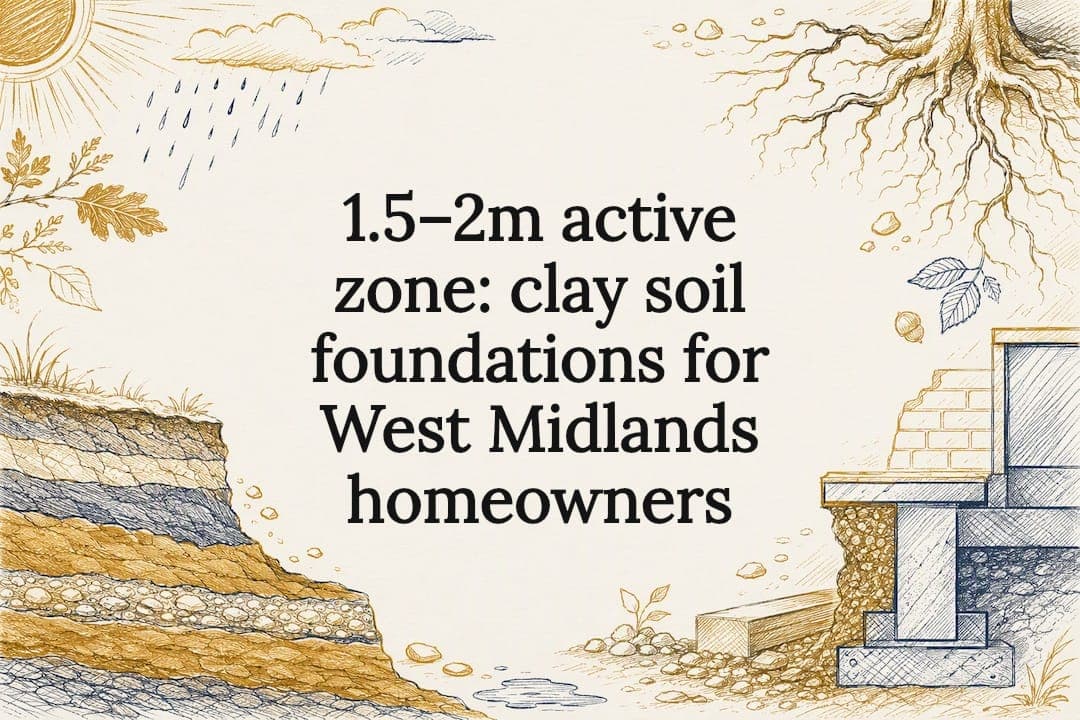
The movement happens in what geotechnical engineers call the active zone: the depth range where seasonal moisture changes actually reach. This is commonly 1.5 to 2 metres, though it can extend to 5 metres in drought-prone areas or near thirsty trees. Engineers measure a soil's volume-change potential (VCP) through laboratory testing, and that figure drives the foundation depth and type you'll need.
This isn't a static risk. Shrink–swell ground movement is a large, continuing cost to the UK economy, with projections indicating costs may increase as weather extremes intensify, according to research published via the Geological Society and NERC. The British Geological Survey treats shrink–swell as one of the country's major geohazards and offers GeoSure and GeoClimate mapping tools that model how susceptibility will shift under different climate scenarios.
What this means for anyone planning to build:
- Check your site's GeoClimate rating before finalising a foundation design, not after.
- Treat historical rainfall patterns as a poor guide to future risk.
- Assume the active zone on a clay site is deeper than it looks from the surface.
Why clay soils cause subsidence, heave and differential movement
Subsidence happens when clay beneath a foundation dries and shrinks, and the ground drops away from under the structure. Heave is the opposite: clay that's been dried out (often by a removed tree) rehydrates and swells, pushing floors and foundations upward. Differential movement is the real damage-maker, where one part of a building moves more than another, twisting the structure and cracking walls diagonally rather than settling evenly.
Common triggers include:
- Seasonal moisture swings, worse in prolonged dry summers
- Mature trees drawing water from beneath foundations
- Leaking drains or water pipes saturating clay unevenly
- Changed surface drainage, such as new patios directing rainwater against a wall
Roughly a third of UK subsidence claims relate directly to clay shrinkage triggered by nearby vegetation, based on insurer data referenced across industry guidance on shrink–swell risk. Watch for diagonal cracks wider at the top, doors and windows sticking seasonally, or cracks that open and close with the weather. Any crack wider than 5mm, or one that's actively growing, warrants a call to a structural engineer rather than a DIY fix.
Site investigation and geotechnical testing: what to commission
A proper site investigation follows a sequence, and skipping steps to save money almost always costs more later.
- Desk study: reviewing historical maps, BGS borehole records and known ground conditions in your area.
- Walkover survey: an engineer inspects tree positions, existing cracking, drainage and any visible signs of movement.
- Intrusive investigation: boreholes or trial pits sample the soil at various depths, ideally reaching below the active zone.
- Laboratory testing: samples go through Atterberg limits testing to establish the plasticity index, plus swell tests and sometimes CBR (California Bearing Ratio) testing to quantify how the clay will behave under load and moisture change.
Each test feeds directly into design. The plasticity index tells your engineer how reactive the clay is; groundwater and contamination notes affect whether you need dewatering or extra waterproofing; the active zone depth sets your minimum foundation depth.
Pro Tip: Don't treat ground investigation as a cost to minimise. Industry guidance suggests allocating 3 to 10% of project budget to GI on more complex projects, and underinvestigating typically forces engineers into conservative, more expensive designs to cover the uncertainty they weren't paid to resolve.
The final geotechnical report should give you clear numbers: soil parameters, confirmed active zone depth, groundwater levels, and any contamination flags for made ground. If your report is vague on any of these, ask for clarification before your engineer finalises a design.
Foundation options for clay soils: trench-fill, raft or piles
There's no single "best foundation for clay soil". The right choice depends on your VCP result, tree proximity and site history, and picking wrong means paying for it twice.
Reinforced trench-fill or deep strip foundations work where VCP is low to medium and trees or drainage risks are properly managed. Depth typically needs to reach below the active zone, often 1.5 metres as a minimum on clay sites, sometimes considerably more near mature trees. They're the cheapest and quickest option but offer little tolerance if ground conditions turn out worse than expected.
Raft foundations spread the building's load across a wide, reinforced concrete slab rather than concentrating it in trenches. This makes them genuinely effective at managing differential settlement because the raft moves as one rigid unit rather than letting one corner sink independently. Rafts suit sites with moderate VCP where full piling feels excessive but trench-fill risk feels too high.
Piled foundations, or piled raft systems, transfer structural loads down past the unstable clay layer to firmer strata below. This is the route for high VCP sites, significant nearby trees, or made ground with contamination. Piling costs more and takes longer, but it's the most reliable answer where shrink–swell risk is severe.
Trade-offs in practice:
- Trench-fill is fastest and cheapest but least forgiving of surprises.
- Rafts add cost over trench-fill but reduce the risk of costly remedial underpinning later.
- Piling has the highest upfront cost and longest programme but the lowest long-term movement risk.
- Disruption scales roughly with depth: piling rigs need more site access and generate more noise than trench excavation.
Your engineer should be pricing these options against your actual GI results, not defaulting to the most expensive route out of caution, or the cheapest out of budget pressure.
Design decisions that cut long-term movement risk
Getting the foundation type right solves half the problem. The rest comes down to managing the moisture regime around the building for its whole life.
- Assess every tree on and near the site. Species matters as much as size: a large poplar or oak can draw enough water to influence clay behaviour over 20 metres away, according to surveyor guidance on tree distances. Note species, mature height and distance in your GI brief.
- Never remove a mature tree near clay-bearing ground without specialist advice. Cutting down a tree that's been drying the soil for decades can trigger heave as the ground rehydrates, and this reverse risk is often as damaging as the original shrinkage.
- Get surface drainage right. Falls should direct water away from foundations, soakaways need to sit well clear of the building, and any new hard landscaping shouldn't create ponding against a wall.
- Route services carefully. Drains and water pipes running near foundations need flexible joints and regular inspection, since a slow leak is one of the most common causes of localised clay swelling that engineers see on site visits.
Pro Tip: If you're planning to remove a tree as part of your extension works, get your engineer's sign-off first and consider phased removal rather than felling it all at once, particularly on shrinkable clay.
Soil stabilisation: an alternative to deep foundations
Lime and cement stabilisation change how clay behaves at a chemical level, reducing its plasticity and swelling potential rather than simply avoiding the problem by digging deeper. Mixing hydraulic binders like lime, cement, GGBS or fly ash into clay is a technique with a long history in road construction, and it's increasingly applied in residential groundworks where soil conditions allow it.

Treated soil becomes a realistic option on marginal clays or brownfield sites, and it can shorten the programme by avoiding imported fill and the cost of trucking excavated material to landfill. Piling still wins out where VCP is high, contamination is significant, or the site simply doesn't suit in-situ mixing.
Validation matters here more than with conventional foundations, because performance depends heavily on mixing quality and curing conditions. Expect in-situ plate or load testing plus compressive strength testing on cured samples, and NHBC guidance on hydraulically treated soils sets out the post-construction checks that confirm the treatment actually worked.
| Factor | Conventional excavation and piling | Lime/cement stabilisation |
|---|---|---|
| Best suited to | High VCP, contaminated or made ground | Marginal clays, brownfield sites with manageable contamination |
| Testing required | Boreholes, Atterberg limits, pile load tests | Plate/load tests, cured-sample compressive strength |
| Typical advantage | Reliable for severe shrink–swell risk | Shorter programme, less imported fill and landfill waste |
Standards and building regulations for foundations on clay
Design work should reference Approved Document C, which sets out site investigation stages and moisture resistance requirements, alongside relevant BRE digests on shrinkable clays. Building control will expect a proper ground report before signing off foundation depths. If your project involves dewatering below the water table, factor in the time needed for an Environment Agency permit, since assessment can take up to four months.
How a structural engineer helps, and realistic costs and timelines
The typical sequence runs from initial site survey to desk study and GI, then structural design, then construction monitoring once digging starts. Each stage feeds the next, so rushing the GI to save a few weeks usually costs more time later when the design has to be revised.

Cost drivers on clay sites include foundation depth, whether piling is needed, tree removal or protection measures, and any dewatering requirements. A small residential extension with straightforward trench-fill foundations might move from survey to groundworks in six to eight weeks; a site needing piling or stabilisation testing can easily add several weeks more. Bring in a tree consultant where mature trees sit close to the build, and a hydrogeologist or dewatering specialist if groundwater is a live issue.
Long-term monitoring keeps small movements from becoming big repairs
Foundations on clay don't stop moving the day construction finishes, and the properties that fare best are the ones where someone keeps an eye on things afterwards. Seasonal monitoring matters most in the first few years after a build or extension, while the ground around the new foundation settles into its altered moisture regime.
Simple checks catch problems early: photograph any hairline cracks and note the date, check they aren't widening season to season, and keep an eye on external drainage for blockages or new leaks. Crack monitoring tell-tales, small gauges fixed across a crack, give an engineer objective data on whether movement is ongoing or historic, which matters enormously when you're trying to work out whether a crack needs structural repair or just redecorating.

Pay particular attention after any change nearby: a felled tree two doors down, new drainage works on the street, or a prolonged drought. These are exactly the conditions that reactivate shrink–swell movement in clay that had settled years ago. Keep records of any building work, tree removal or drainage changes on your own property too, since this history becomes valuable if you ever need to make an insurance claim or brief an engineer on a developing problem.
Annual visual inspections cost nothing beyond ten minutes with a torch and a notebook, and they're the difference between catching a hairline crack early and discovering a serious lean in a wall years later.
Fixing existing foundation damage caused by clay soil
Underpinning remains the standard fix where subsidence has already caused significant differential movement. It works by extending the foundation down to more stable ground or by transferring load to piles, effectively giving a damaged foundation the depth or bearing capacity it should have had from the start. It's disruptive and not cheap, but it's a well proven solution where movement has genuinely undermined a structure.
Moisture control addresses causes rather than symptoms. Fixing leaking drains, correcting surface drainage that's been pooling water against a wall, and managing problem trees can halt further movement without any underpinning at all, particularly where damage is limited to cosmetic cracking rather than structural distortion.
The right approach depends entirely on cause and severity, which is exactly why a structural engineer needs to establish what's actually driving the movement before any remedial work starts. Underpinning a house where a leaking drain is the real culprit fixes nothing long term if that drain isn't also repaired. Get a proper diagnosis first, and treat the underlying moisture problem as seriously as the structural repair itself.
What we've learned building on clay across the West Midlands
Ground investigation and structural engineering aren't add-ons in a managed extension build process. They're built in from the first site visit, because a foundation surprise halfway through a build is the single biggest cause of blown budgets and delayed handovers. Where marginal clay allows it, we'll weigh stabilisation against piling honestly, on cost and disruption, not just default caution.
— Raja
Get a site survey before you commit to a design
One comprehensive service model manages ground investigation, engineering, planning submission, and construction together, so foundation decisions on clay-bearing sites get made properly the first time, not revised mid-build once something's already been dug.

Realistic budgeting starts before any site survey, which matters enormously on clay where a piling requirement can shift your numbers significantly from an initial trench-fill estimate. If you're planning a rear, wrap-around, or double-storey extension anywhere across Birmingham, Solihull or the wider West Midlands, browse our recent extension projects including a single-storey rear extension in Solihull where groundworks were managed as part of the full build. For a clearer sense of what foundation work on clay typically adds to a project, our guide to extension costs across the West Midlands breaks down the main drivers. Get in touch through the Extensionkings site to book a site survey and find out what your ground actually needs.
Where to check the detail yourself
- British Geological Survey GeoSure and GeoClimate: map local shrink–swell susceptibility and future climate projections.
- Approved Document C: statutory guidance on site preparation and moisture resistance.
- The Concrete Centre on soil stabilisation: technical detail on lime and cement ground treatment.
- Integra on concrete and steel structural design: further technical background on structural detailing for challenging ground.
Sources
- Shrink–swell research (Geological Society / NERC repository)
- Latest research emphasises climate-related subsidence risk to millions of British homes (BGS)
- Soil stabilisation and solidification (The Concrete Centre)
- Approved Document C: Site preparation and resistance to moisture (UK government)
- Geotechnical design and conservatism (Institution of Civil Engineers)
FAQ
What foundation is best for clay soil?
There's no universal answer. Reinforced trench-fill suits low to medium volume-change potential, raft foundations spread load well on moderate risk sites, and piled foundations handle high VCP or heavily treed sites. The right choice depends on your geotechnical report, not a generic rule.
Is clay soil good for foundations?
Clay itself has decent bearing capacity, but its shrink–swell behaviour makes it risky without proper investigation and design. Left unmanaged, moisture-driven volume change is a major cause of UK subsidence damage, so clay soil demands more design care than sand or gravel, not necessarily a worse outcome.
How deep should foundations be on clay soil?
Foundations typically need to reach below the active zone, commonly 1.5 to 2 metres, though depths of 3 metres or more aren't unusual near mature trees or on highly reactive clay. Your geotechnical report, not a fixed rule of thumb, should set the actual figure for your site.
What happens to houses built on clay soil without proper foundations?
Seasonal drying and wetting cause the clay beneath shallow foundations to shrink and swell unevenly, leading to subsidence, heave, or differential movement that shows up as diagonal cracking, sticking doors, and sloping floors. Left unaddressed, this can require underpinning, which costs considerably more than getting the foundation design right from the outset.
Does Extensionkings handle the ground investigation as part of a build?
Yes, Extensionkings manages site investigation and structural engineering as part of its design-and-build service across the West Midlands, so foundation decisions are made with proper data rather than assumptions. Current pricing depends on project scope and is available directly through the Extensionkings site.