
For most homes, low-E glass beats clear glass on energy efficiency, full stop. A low-E coated pane typically achieves a centre-pane U-value of around 1.0 to 1.2 W/m²K, against roughly 2.7 to 3.2 W/m²K for standard clear float glass. The main trade-off is cost, not comfort: expect to pay a premium upfront, and if a room faces due south with a lot of glazing, you may need a solar-control variant rather than standard low-E.
TL;DR:
- Low-E glass offers about 55 to 60% better thermal performance than clear glass, with U-values around 1.0 to 1.2 W/m²K versus 2.7 to 3.2 W/m²K for clear glass.
- The premium for low-E glass ranges from £40 to £80 per square meter and typically pays for itself in about 5 to 10 years through heating savings of approximately £100 to £200 annually on gas-heated homes.
- Whole-window U-value depends heavily on frame quality, spacer type, and gas fill, making it essential to consider these factors alongside the glass specifications for accurate performance assessment.
- Modern low-E glass appears nearly identical to clear glass and is most suitable for north-facing rooms and large glazed areas, with sunny south-facing applications often requiring solar-control low-E variants.
- Proper installation, framing, and gas filling are crucial for maximizing low-E glass benefits, and homeowners should request comprehensive U-value calculations and verify coating placement before purchase.
Table of Contents
- Low-e vs clear glass: the key differences at a glance
- Performance: what U-values, emissivity and SHGC actually tell you
- Does low-E glass look different from clear glass?
- What does low-E glass actually cost, and how fast does it pay back?
- When low-E earns its premium, and when clear glass is fine
- Frames, spacers and gas fills: why the glass is only half the story
- How to tell if glass is low-E and what to ask before you buy
- What extension glazing projects teach you about low-E in practice
- A practical note on making the right call
- Getting your glazing specified properly during an extension
- Sources
- FAQ
Low-e vs clear glass: the key differences at a glance
The gap between these two products shows up in four places: heat retention, solar control, how much daylight gets through, and price.
- Insulation: low-E glass retains far more heat than clear glass, thanks to a coating that reflects long-wave heat back into the room.
- Solar and UV control: low-E coatings block a meaningful share of UV and manage solar heat gain; clear glass does neither.
- Visible light: modern low-E is close to invisible to the eye; older hard-coat versions carry a faint tint.
- Installation: low-E units need a soft-coat face positioned correctly inside the sealed unit; clear glass has no such requirement.
- Cost: low-E carries a premium per square metre; clear glass is the cheaper baseline.
For quick guidance by room: north-facing rooms benefit most from standard low-E, south-facing rooms often need solar-control low-E, conservatories almost always need it, and small, low-priority openings can sometimes get away with clear glass. The numbers behind these recommendations matter more than the labels, so let's look at what U-value and emissivity actually measure.
Performance: what U-values, emissivity and SHGC actually tell you
The centre-pane U-value is the figure that separates these two products most clearly. Low-E coated glass typically sits at 1.0 to 1.2 W/m²K, compared with 2.7 to 3.2 W/m²K for clear float glass sealed units, a roughly 55 to 60% improvement in glass-only thermal performance. Lower U-values mean less heat escaping through the pane in winter.
Low-E vs clear glass, in one number: switching from clear to low-E glass cuts glass-only heat loss by around 55 to 60%, based on centre-pane U-value comparisons.
Emissivity explains why. It measures how much long-wave heat a surface radiates rather than reflects back. Soft-coat low-E (the sputtered type used in almost all modern sealed units) achieves emissivity of roughly 0.02 to 0.05, against 0.15 to 0.20 for hard-coat low-E. Clear glass has no coating at all, so it radiates heat freely.
Solar Heat Gain Coefficient, or SHGC, measures how much solar energy passes through the glass as usable heat. A high SHGC is welcome in a cold, north-facing room where you want free solar warmth; a low SHGC matters more on a south-facing wall or a conservatory roof, where the same sun becomes a liability. This is where solar-control low-E variants earn their keep.
| Metric | Low-E glass | Clear glass |
|---|---|---|
| Centre-pane U-value | 1.0–1.2 W/m²K | 2.7–3.2 W/m²K |
| Emissivity (soft-coat/hard-coat/clear) | 0.02–0.05 / 0.15–0.20 | No coating |
| Solar control | Adjustable via coating type | None |
None of this happens in isolation, though. Whole-window U-value, the figure that actually governs Approved Document L compliance, depends on the frame, the spacer bar, and whether the cavity is filled with argon rather than plain air. A brilliant pane in a poor frame still underperforms.
Does low-E glass look different from clear glass?
Visually, modern low-E glass is close to indistinguishable from clear glass in daily use. Soft-coat low-E is engineered to be neutral in appearance, cutting visible light transmission by only around 5 to 8% in most residential specifications, which is not something most people notice room to room.
- Modern soft-coat low-E: effectively neutral, minor light reduction of roughly 5 to 8%.
- Older hard-coat low-E: carries a faint tint, still used in some single-glazed retrofit and specialist applications.
- Slight colour shift can appear at extreme viewing angles, more visible on large picture windows.
- Matching new low-E units to older clear-glass windows nearby is usually straightforward, but ask your supplier to check the coating batch if colour consistency across a whole elevation matters to you.
If you're comparing samples in a showroom under artificial light, the difference can look more obvious than it will once the glass is installed and viewed against daylight from a normal distance.
What does low-E glass actually cost, and how fast does it pay back?
The clearness of low-E glass isn't the deciding factor for most buyers. Cost is. UK cost modelling puts the low-E premium at roughly £40 to £80 per square metre over a standard clear-glass double-glazed unit, with typical annual heating savings of £100 to £200 for a gas-heated semi-detached home.
Low-E glass in the UK adds an estimated £40 to £80 per square metre and can save a gas-heated semi-detached home £100 to £200 a year on heating, giving a payback window of roughly 5 to 10 years.
A worked example makes the maths concrete. Take a semi-detached home with 15m² of window area being replaced:
- Low-E premium: 15m² × £60 average = £900 extra spend over clear glass.
- Annual saving: assume the mid-point figure of £150 a year for this size of property.
- Simple payback: £900 ÷ £150 = 6 years, comfortably inside the typical 5 to 10 year window.
That estimate moves with three variables: your fuel tariff (electric heating tends to shorten payback because electricity costs more per unit than gas), the total area of glazing being replaced, and orientation, since a heavily shaded north-facing extension will save less than a sun-exposed south wall. Payback shortens further if you're replacing single glazing entirely rather than swapping like-for-like double glazing.
When low-E earns its premium, and when clear glass is fine
Low-E is worth specifying almost every time you're doing a full window replacement or building an extension with real heat-retention goals. It makes the biggest difference in north-facing rooms that get little free solar warmth, and in any space with a large glazed area, where heat loss through glass dominates the room's overall energy performance.
Clear glass remains a reasonable choice in narrower circumstances:
- Small openings on a north or shaded elevation, where the U-value gap has less practical impact.
- Heritage or conservation projects where matching historic glazing exactly outweighs efficiency gains.
- Tight initial budgets on secondary or low-use rooms, provided the rest of the building envelope is sound.
Large south-facing glazing, conservatories and rooflights sit in a different category entirely. The Glass and Glazing Federation advises solar-control low-E for these situations specifically, because standard low-E retains heat so effectively that an unshaded south wall can turn a room into a greenhouse in summer.
Pro Tip: If you're unsure which way a room faces relative to the sun, check at midday in summer rather than guessing from a floor plan. A room that looks north-facing on paper can still get strong afternoon sun through a side window.
Frames, spacers and gas fills: why the glass is only half the story
Buying the best glass for windows and installing it in a poor frame wastes most of the potential saving. Whole-window U-value, not centre-pane U-value, is what governs your actual heating bill and your compliance with Approved Document L.
- Frame material and thermal breaks matter as much as the glass itself; aluminium frames need a thermal break to avoid becoming a cold bridge.
- Spacer bar type affects the edge of the sealed unit, where heat loss concentrates if the spacer is a poor insulator.
- Argon gas fill between panes reduces convective heat transfer compared with ordinary air, adding a modest but real improvement.
- Seal quality determines whether that argon fill stays put for the unit's working life.
Testing conventions such as BR 443 and BS EN ISO hot-box methods exist precisely because centre-pane figures overstate real performance. Soft-coat low-E also requires edge deletion, a narrow band of coating ground off the perimeter before sealing, to allow a reliable secondary seal to form. Skip that step and the unit risks premature seal failure.
Pro Tip: Ask any supplier for the whole-window U-value calculation method they used, not just the glass spec. A quote that only cites centre-pane figures is telling you half the story.
How to tell if glass is low-E and what to ask before you buy
Low-E coatings are invisible to the naked eye in most cases, so you need to ask the right questions rather than rely on looking at the pane.
- Ask for the labelling or spacer bar etching, which often identifies the glass type and manufacturer.
- Request the centre-pane U-value and the coating's face number (which pane surface carries the coating), since incorrect positioning reduces performance.
- Ask which whole-window U-value calculation method was used, whether the unit is argon-filled, and what spacer type is specified.
- Watch for warning signs: an exposed, touchable coating on a supposedly finished unit, or unsupported claims that single glazing performs like sealed low-E units.
- Check the guarantee length on the sealed unit itself, separate from the frame guarantee.
What extension glazing projects teach you about low-E in practice
On extension work, glazing choices usually come down to rooflights and large full-height panels facing the garden. Low-E is specified as standard on nearly every one of these, because the glazed area is often the single biggest source of heat loss in a new room. A recent kitchen extension with rooflights in Halesowen shows how solar-control low-E gets specified on roof glazing to manage summer heat gain while still holding onto winter warmth.
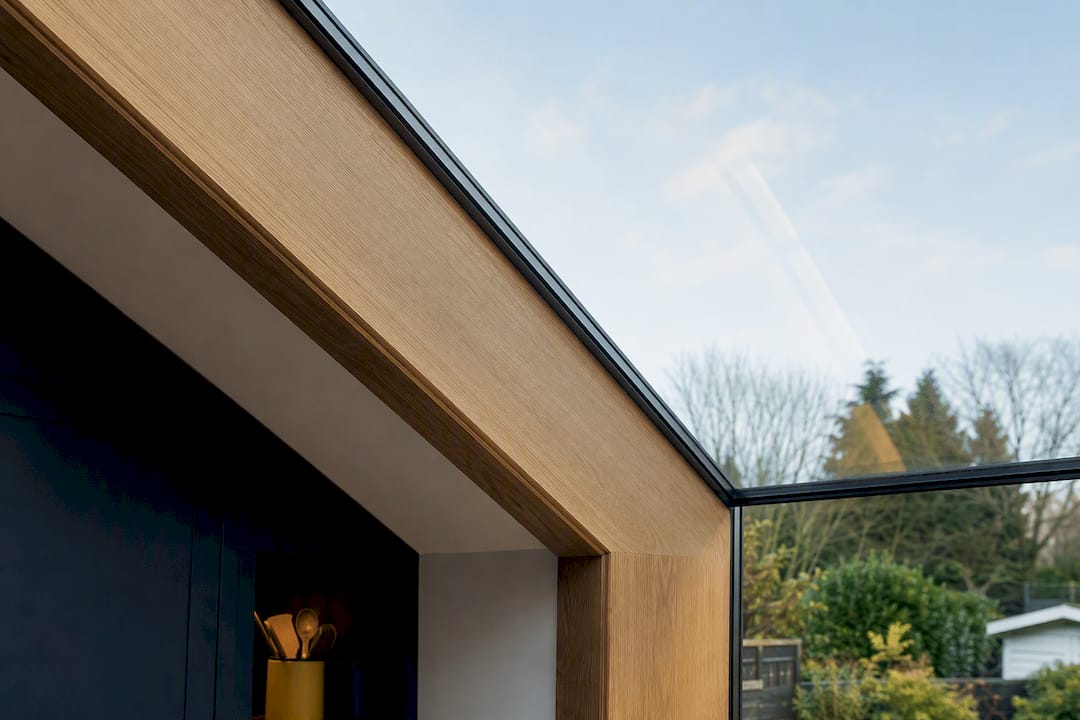
The recurring on-site issues are rarely about the glass performing badly. They're about mismatched panes between phases of a project, lead times on solar-control variants running longer than standard stock, and clients mistaking external condensation for a fault when it's often a sign the glazing is doing its job well.
A practical note on making the right call
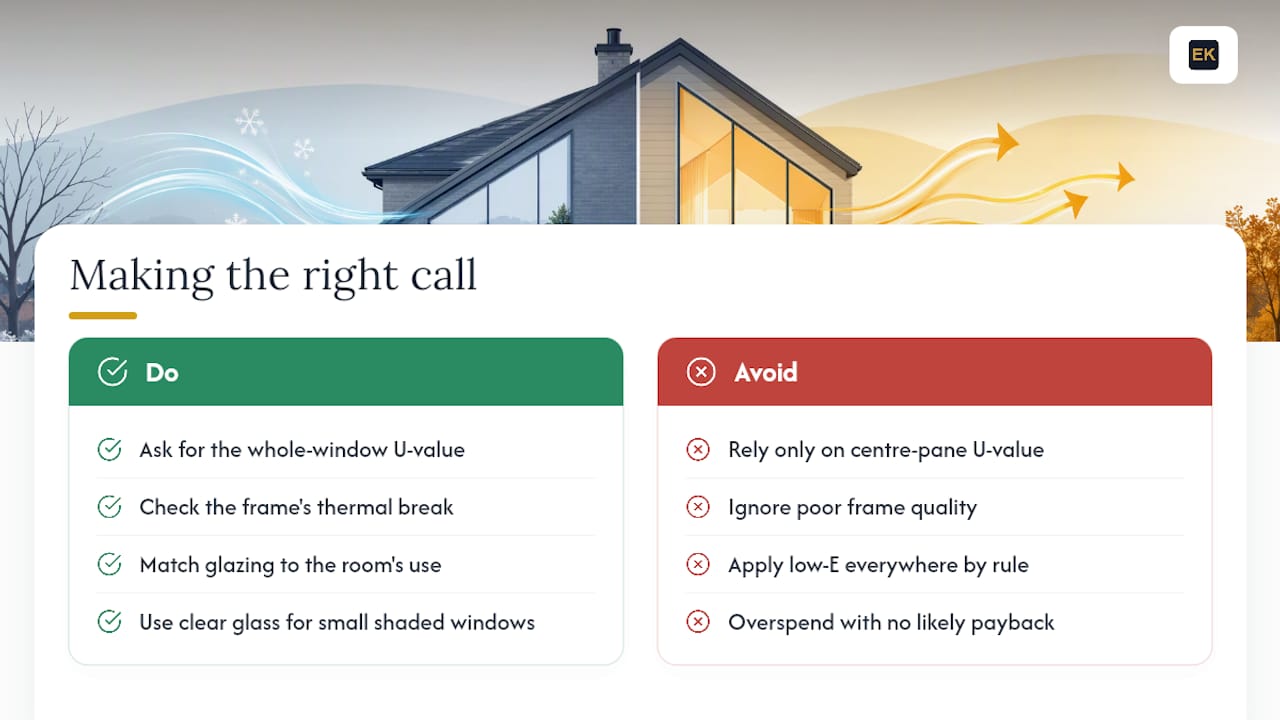
Most homeowners overthink the glass and underthink the frame. The centre-pane U-value gets all the attention in sales conversations, but a mediocre frame with a poor thermal break can quietly erase half the benefit you paid for. If there's one thing worth pushing back on with any supplier, it's asking for the whole-window figure, not just the glass spec sheet.
The other thing worth saying plainly: clear glass isn't a mistake in every context. On a small, shaded utility window with a tight budget, spending extra on low-E rarely pays back inside a sensible timeframe. Match the spec to the room, not to a blanket rule. If you're weighing up glazing for an extension and want a second opinion on what's actually worth specifying, get in touch and we'll talk it through.
— Raja
Getting your glazing specified properly during an extension
Getting the glazing right on an extension means more than picking a U-value off a spec sheet. Extensionkings manages the full process for homeowners across the West Midlands, from working out the right glazing for rooflights and full-height glazed walls through to handling the building regulations paperwork that whole-window U-values need to satisfy.

Rather than juggling a glazier, a builder, and planning permission separately, you get one team managing the extension from design through to handover, including the glazing decisions that most affect your long-term heating costs. That matters most on rear extensions with large glazed doors or kitchen-diners with rooflights, where the glass makes up a big share of the room's total heat loss. If you're planning an extension in Birmingham, Solihull, or the wider West Midlands, check areas we cover and request a site visit to talk through glazing options and get a realistic quote for your project.
Sources
- Conservation of fuel and power: approved document L (2026)
- Low-E (Low Emissivity) Glass and thermal efficiency — GGF
- Improving glass performance with low-E coatings — Glazing Vision
- Low-E coatings explained — Pane Relief
- Low-E glass UK 2026 cost and benefit — Axiom Eco Homes
- Low E glass — Regency Glass
FAQ
What are the downsides of low-E glass?
The main downside is cost, typically £40 to £80 more per square metre than clear glass, and on large south-facing glazing, standard low-E can trap too much solar heat unless a solar-control variant is used.
When should you use low-E glass instead of clear glass?
Use low-E for whole-window replacements, north-facing rooms, and any extension or room with a large glazed area, since these are where the U-value improvement makes the biggest difference to comfort and heating costs.
How can you tell if glass is low-E?
Check the spacer bar etching or ask the supplier for the coating's face number and centre-pane U-value, since soft-coat low-E is visually neutral and can't reliably be identified by eye alone.
Is external condensation on low-E windows a problem?
No, external condensation on the outer pane is usually a sign the glazing is insulating well, because the coating keeps the outer surface colder rather than letting heat escape through it.