

Most rear and side extensions with foundations close to a boundary trigger the Party Wall etc. Act 1996, and yes, that almost certainly includes yours if you're digging within 3 to 6 metres of a neighbour's foundations. The immediate move is to finalise your drawings so you know actual foundation depths and boundary positions, then serve the correct written notice, giving the statutory minimum notice period required by the Act for different types of works before starting any excavation or construction, before you touch a spade.
TL;DR:
- Serving notices too early risks expiration or misalignment with the final design, so confirm foundation depths and boundary details before acting.
- The typical elapsed time for the full party wall process extends to three to four months if neighbours dissent or responses are delayed.
- A non-response within 14 days is legally treated as dissent, triggering surveyor procedures identical to an explicit objection.
- Cost factors include surveyor fees generally between £1,000 and £2,500 per Award, with delays mainly caused by disagreements requiring a third surveyor.
- A Schedule of Condition provides vital baseline evidence to prevent disputes over damage, and it should be coordinated before starting works.
Table of Contents
- What the Party Wall etc. Act 1996 actually covers
- How do you serve a valid party wall notice?
- What happens if your neighbour doesn't respond within 14 days?
- Surveyors and the Party Wall Award: who does what, and who pays
- Why a Schedule of Condition matters even when your neighbour agrees
- What does the party wall process cost, and how long does it actually take?
- Common mistakes that delay or derail the party wall process
- How a managed extension contractor handles the party wall process
- Official guidance and templates to download
- The party wall process isn't the obstacle homeowners think it is
- Sources
- FAQ
What the Party Wall etc. Act 1996 actually covers
The Act splits into three practical tests, and once you know them, working out whether your project is notifiable takes about five minutes with a set of drawings in front of you.
Section 1 deals with building a new wall at or astride the boundary, known as the line of junction. If you're putting up a new garden wall or an extension wall that sits on the boundary line itself, this section applies, and you get one month's notice to serve.
Section 2 covers work to an existing party wall or party structure. This is the one that catches most extension projects: cutting into a shared wall to insert a beam, raising a party wall, underpinning it, or even repointing and repairing it in some cases. Building a rear extension where the flank wall is shared with next door, or where you're inserting a steel beam that bears onto a party wall, falls squarely here.
Section 6 is the excavation trigger, and it's the one homeowners most often miss because it has nothing to do with touching the wall itself. It applies when you excavate within 3 metres of a neighbouring building and your new foundations will go deeper than theirs, or within 6 metres if a line drawn at 45 degrees downward from the neighbour's foundation would be cut by your excavation. This is why even a rear extension on a semi-detached or terraced house, sitting well clear of any shared wall, can still need notice.
Testing your project against these rules:
- Get scaled drawings from your architect or structural engineer showing exact foundation depths, not estimates.
- Measure the horizontal distance from your proposed foundations to the neighbouring building, not just to the fence line.
- Run the 3-metre test first: if excavation is within 3 metres and deeper than the neighbour's foundations, Section 6 applies.
- If you clear the 3-metre test, run the 6-metre/45-degree test before assuming you're exempt.
- Check whether any wall you're altering is legally shared, rather than simply adjacent, since this affects whether Section 2 applies.
Detached houses are not automatically exempt. A detached property with generous garden depth might clear both excavation tests, but a detached house on a tight urban plot, common across parts of Birmingham and the Black Country, can still trigger Section 6 if new foundations sit close to a neighbour's boundary wall or outbuilding. The explanatory booklet published alongside the Act sets out these triggers in full, and it's worth reading before you finalise your design brief.
How do you serve a valid party wall notice?
Getting the notice itself right matters more than most homeowners assume, because a defective notice can be challenged and you'll end up serving again, losing weeks in the process.
Start by identifying which notice type, or combination, your project needs. A line of junction notice covers new boundary walls under Section 1. A party structure notice covers Section 2 works to an existing shared wall. A notice of adjacent excavation covers Section 6 digging. Many extension projects need two of these simultaneously: a party structure notice for the steel going into the shared wall, and an excavation notice for the new foundations nearby. Serve both together where they overlap, rather than staggering them and confusing your neighbour about what's actually happening.
Building a valid notice, step by step:
- Confirm the exact boundary and ownership using the Land Registry title register, which costs a few pounds and removes any doubt about who the adjoining owner actually is.
- State your name and address as building owner, plus the adjoining owner's name and address, exactly as they appear on the title.
- Describe the proposed works in plain terms: what you're building, where, and which structure is affected.
- State the type of notice being served and the section of the Act it falls under.
- Attach drawings showing foundation depths and distances from the boundary for any excavation notice; a notice without this detail is one of the most common reasons neighbours dispute or delay a response.
- Date the notice clearly, since this date starts the statutory clock.
- Serve it by hand, by recorded post, or by leaving it at the property, and keep proof of the method and date used.
Pro Tip: Never rely on email or a verbal conversation as your formal notice, even if your neighbour is friendly and agrees informally. Deemed dissent only stops the clock if you can prove a compliant written notice was served on a specific date, and a text message or a chat over the fence won't hold up if a dispute later arises over damage or access.
If the neighbouring property is let, you may need to serve the tenant as well as the freeholder, depending on the circumstances and works involved. Where ownership is unclear, split, or the property has multiple leaseholders, checking the Land Registry title first avoids serving the wrong party and having to restart the clock.
What happens if your neighbour doesn't respond within 14 days?
Once served, your neighbour has 14 days to respond, and what happens next depends entirely on how they reply, or whether they reply at all.
Written consent is the best outcome: your neighbour signs to agree the works, and you can proceed without a Party Wall Award. Even here, it's worth commissioning a Schedule of Condition before work starts, because consent to the works isn't the same as agreement on the property's existing condition, and a signed consent offers no protection if a crack appears later and nobody recorded whether it was already there.
Dissent happens when the neighbour formally objects, usually because they want their own surveyor involved or have concerns about access, vibration, or damage. This is not a rejection of your project; it simply moves the process into the surveyor route set out in the Act.
Deemed dissent is the one that catches homeowners out. If your neighbour simply doesn't reply within the 14-day window, the legislation treats that silence as a dispute, not as consent. Many people assume no news is good news. It isn't. A non-response, even from an entirely agreeable neighbour who's just away or disorganised, triggers exactly the same surveyor process as an active objection.
Resolving a dispute once it's triggered:
- An agreed surveyor, appointed jointly by both owners, is usually the fastest and cheapest route, since one professional handles the whole Award.
- Two surveyors, one appointed by each owner, is common where relations are tense or the works are complex; they then need to agree between themselves.
- A third surveyor is selected in advance by the two appointed surveyors and only steps in if those two can't agree on a point, acting as a referee rather than a third opinion from scratch.
Whichever route applies, the surveyor's job from this point is to produce a Party Wall Award, the legally binding document that sets the terms under which your works can proceed.
Surveyors and the Party Wall Award: who does what, and who pays
Surveyors appointed under the Act, whether acting as the agreed surveyor or one of two, have a specific legal duty: they must act impartially, even the surveyor you appointed and are paying. RICS guidance is explicit on this point: a party wall surveyor is not your advocate. They're a quasi-judicial appointee whose job is to weigh both owners' interests and produce a fair Award, not to fight your corner. This surprises a lot of homeowners who expect "their" surveyor to push their case.
What a Party Wall Award typically contains:
- The precise scope of works permitted, often cross-referenced to the drawings submitted with the notice.
- Working methods and any conditions attached, such as working hours, vibration limits, or requirements around underpinning technique.
- A Schedule of Condition recording the state of the adjoining property before work starts.
- Rights of access for the surveyor and, where necessary, for the building owner's contractors to carry out the works.
- Provision for the surveyor's fees and, where relevant, compensation for any damage caused.
Cost snapshot: surveyor fees for producing an Award typically run from around £1,000 to £2,500, and where a dispute has to go through the full two-surveyor or third-surveyor route, allow 8 to 12 weeks for the Award to be finalised.
As the building owner carrying out the works, you almost always pay the surveyor's fees, including the adjoining owner's surveyor if they've appointed one separately. This is standard practice under the Act rather than a sign you've been outmanoeuvred; it reflects the principle that the person benefiting from the works bears the cost of the process protecting the neighbour.
Once issued, an Award is legally binding on both parties. Either owner has 14 days to appeal to the county court if they believe it's wrong, but outside that window, the Award stands, and it can be enforced like any other legal document if either side ignores its terms, whether that's a building owner starting work outside agreed hours or an adjoining owner blocking legitimate access.
Why a Schedule of Condition matters even when your neighbour agrees
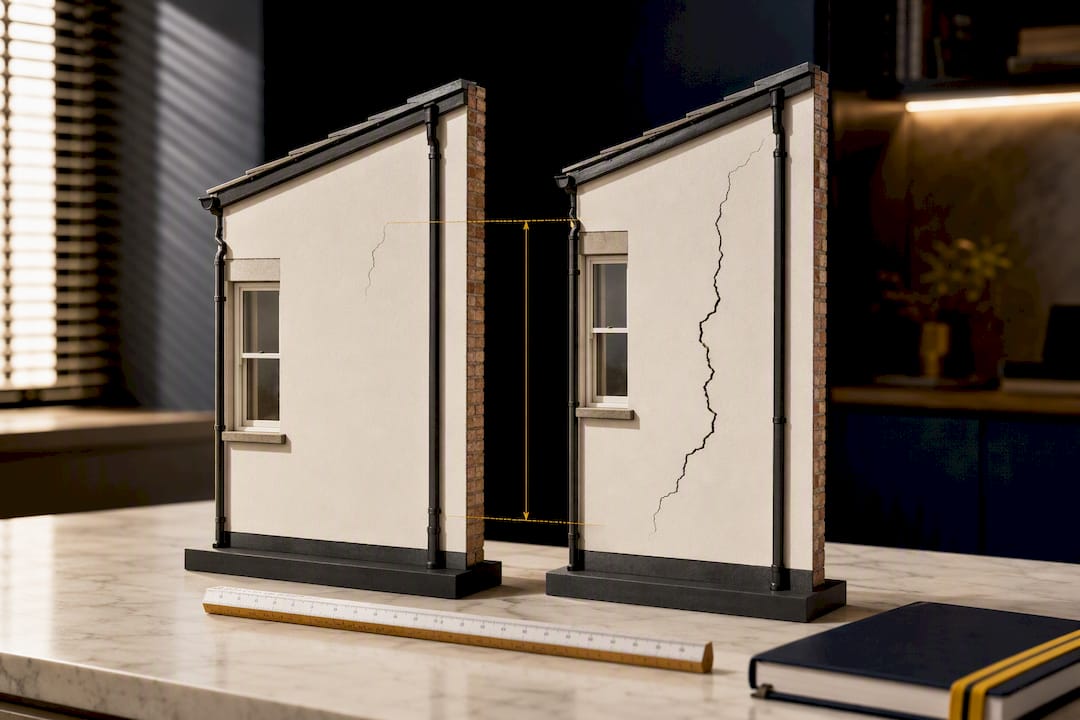
A Schedule of Condition is a detailed photographic and written record of a property's condition before your works begin, and it's the single cheapest form of protection in the entire party wall process. Skip it, and any argument about whether your excavation caused that new crack in next door's kitchen ceiling becomes a matter of opinion rather than evidence.
What a proper Schedule of Condition should record:
- Dated, high-resolution photographs of walls, ceilings, floors, and external elevations most likely to be affected by the works.
- Written descriptions of existing cracks, damp patches, uneven floors, or other defects, with measurements or reference points where possible.
- Internal and external coverage, since vibration and settlement can affect rooms well away from the immediate work area.
- A copy held by both the building owner and the adjoining owner, ideally appended directly to the Award.
Commission it either as part of the surveyor's work under the Award, or independently and earlier if your neighbour has given written consent and no surveyor is involved. Independent inspections are usually a modest addition on top of standard survey costs, and that outlay is trivial next to the cost of a disputed damage claim with no baseline evidence.
At completion, the surveyor, or you and your neighbour informally, compare the property's condition against the Schedule. Where new damage clearly wasn't present at the start, it points to the works as the cause and settles the compensation question far faster than a dispute with no starting reference at all.
What does the party wall process cost, and how long does it actually take?
Budgeting for party wall compliance means separating two variables that often get conflated: the statutory minimum notice period, and the realistic elapsed time once you factor in how neighbours actually respond.
The legal minimums are fixed: two months' notice for party structure or excavation works, one month for a new line of junction wall. But those are floors, not typical outcomes. Where a neighbour consents promptly, you might genuinely start work close to those minimums. Where dissent or deemed dissent triggers the surveyor route, realistic elapsed time commonly stretches to 3 to 4 months once you account for surveyor appointment, inspection scheduling, and Award drafting.
| Cost or timing item | Typical range | What drives it higher |
|---|---|---|
| Schedule of Condition (independent) | Modest addition to survey costs | Larger properties, more rooms to record |
| Agreed surveyor route (Award) | £1,000–£2,500 | Complexity of works, underpinning involved |
| Two-surveyor route (per side) | £1,000–£2,500 each side | Disagreement between surveyors, third surveyor needed |
| Minimum statutory notice period | 1–2 months | N/A, fixed by the Act |
| Realistic elapsed time with dispute | 3–4 months | Slow neighbour response, complex Award terms |
The single biggest driver of extra cost and delay is a dispute that pulls in a third surveyor, since that adds another professional's fees and another round of correspondence to reach agreement. Underpinning, basement works, and projects affecting multiple neighbours simultaneously push costs toward the top of these ranges.
On timing within your project programme: serve notice as soon as your drawings confirm the exact foundation depths and boundary position, not before. Notices lapse after 12 months if work hasn't started, so serving too early on preliminary drawings risks the notice expiring before you're ready to build, forcing you to serve again from scratch.
Common mistakes that delay or derail the party wall process
The mistakes that cause the most damage are almost always procedural rather than legal, which is good news because they're entirely avoidable with a bit of forward planning.
The errors homeowners repeat most often:
- Serving notice to the wrong person, often the previous owner, because nobody checked the current Land Registry title before posting it.
- Submitting an excavation notice with vague or missing drawings, which invites dissent simply because the neighbour can't assess the risk to their own foundations.
- Treating a friendly chat over the garden fence as if it were formal consent, then having no evidence when a dispute arises later.
- Starting groundwork before the notice period has expired, or before an Award is in place where ones required, which risks an injunction halting the site.
- Failing to fold the Award's conditions, working hours, access rights, vibration limits, into the actual building contract, leaving the contractor unaware of restrictions the homeowner is legally bound to.
Speaking to your neighbour informally before any notice lands on their doormat genuinely reduces the odds of dissent, because most objections come from surprise and uncertainty rather than genuine opposition to the project.
Pro Tip: Send notices by recorded delivery even when you plan to hand-deliver a copy in person. If your neighbour later claims they never received it, or the date becomes disputed, a postal record settles the argument in minutes rather than dragging into a formal challenge.
Treat complex foundations, basement conversions, or any project touching more than two neighbouring properties as an automatic trigger to bring in a party wall surveyor early, even before you've served notice, rather than after a dispute has already started.
How a managed extension contractor handles the party wall process
At Extensionkings, party wall compliance sits inside the design timeline rather than bolted on afterwards, because the two things depend on each other directly: you can't confirm foundation depths for a notice until the structural design is settled, and you can't finalise the structural design without knowing what's realistic within the boundary constraints next door.
How that typically plays out on a managed project:
- Draft structural drawings are produced early enough that foundation depths and boundary distances are confirmed before the notice window needs to open.
- The project team coordinates directly with an appointed surveyor where a neighbour dissents, so the homeowner isn't left managing correspondence and technical queries alone.
- A Schedule of Condition is commissioned as a standard step rather than an afterthought, protecting both the client and the neighbour if a dispute over damage arises later.
- Award conditions, working hours, access arrangements, vibration limits are written directly into the build programme so the site team never breaches terms the homeowner is legally bound to.
This matters most on projects like a wrap-around extension, where excavation often runs along two boundaries at once rather than one, doubling the number of notices and neighbours involved. Homeowners across Birmingham, Solihull, and the wider West Midlands considering a project of this scale are welcome to get in touch for a project review before drawings are even finalised, so party wall timing gets built into the schedule from day one rather than discovered as a delay later.
Official guidance and templates to download
Start with the explanatory booklet on gov.uk for plain-English guidance on notices, timings, and disputes. For the exact statutory wording behind any procedural question, the Act's full text on legislation.gov.uk is the primary source. RICS's party wall legislation and procedure guidance covers surveyor conduct and Award standards in more technical depth, useful once you're already working with an appointed surveyor.
The party wall process isn't the obstacle homeowners think it is
Most of the anxiety around party walls comes from treating it as a legal minefield rather than what it actually is: a scheduling dependency, no different in kind from waiting for a planning decision or a structural calculation. The conventional advice, "serve notice as early as possible," is actually backwards. Serve too early, on drawings that later change, and you risk a notice that lapses after 12 months or, worse, describes work that no longer matches what you build. The better discipline is patience: finalise the design, confirm the foundation depths, then serve.
Where I think most guides undersell the point is deemed dissent. Homeowners fixate on the idea of an angry neighbour objecting, when in practice, most disputes come from silence, someone busy, indifferent, or simply not reading their post. That single fact should reshape how you plan the whole timeline: budget for the surveyor route as your default expectation, not your worst case. If consent arrives quickly, you've lost nothing. If it doesn't, you're already prepared. And talk to your neighbour before the notice lands. It costs nothing and it's the cheapest dispute prevention in the entire process.
— Raja
This article is general information, not a substitute for advice from a qualified lawyer. Consult a qualified legal professional about your own circumstances before acting on anything here.
Sources
- The Party Wall etc Act 1996: explanatory booklet
- Legislation
- RICS party wall legislation and procedure (7th edition)
- Party Wall Agreements for an Extension: The Complete UK Guide (BuildWiz UK)
FAQ
How do I get a party wall agreement in the UK?
You don't apply for one directly; you serve the correct written notice, line of junction, party structure, or excavation, on your neighbour, and an agreement (or an Award if they dissent) follows from that statutory process rather than a separate application.
How long does the party wall process take?
The statutory minimum is one to two months' notice, but where a neighbour dissents or doesn't respond within 14 days, realistic elapsed time commonly runs to 3 to 4 months once surveyor appointment and Award drafting are factored in.
Can a neighbour refuse a party wall notice?
A neighbour can dissent, which is their right under the Act, but dissent doesn't block your project outright; it simply moves the process into the surveyor route, where an Award ultimately sets the terms for the works to proceed.
Can you sell a house without a party wall agreement?
Yes, you can sell a house even if past works never had a formal party wall agreement, but unresolved party wall issues can complicate conveyancing and may need disclosing to a buyer's solicitor, so it's worth resolving before marketing the property.